

Syslog in Practice: Use Cases and Integrations
Understanding how syslog works is important — but its real value becomes clear when you look at how it’s used in production environments.
In practice, syslog serves as the glue (or pipeline) between systems that generate events and platforms that analyze them, from traditional servers to modern observability and security stacks. Its flexibility allows it to support a wide range of use cases without locking organizations into a single vendor or toolchain.
This section explores the most common real-world syslog use cases and how syslog integrates with downstream systems such as SIEMs, log analytics platforms, and observability tools.
Operating System and Infrastructure Logs
One of the most widespread uses of syslog is collecting operating system–level logs from servers and virtual machines.
Typical Sources
- Kernel messages
- Authentication and authorization events
- Service start/stop events
- Hardware and driver errors
These logs are often the first place engineers look when troubleshooting incidents or investigating outages.
Why Syslog Fits Well
- Native support on Unix/Linux systems
- Consistent format across hosts (at least, in theory)
- Easy forwarding to centralized collectors
Centralizing OS logs also supports incident response and compliance, as discussed in Syslog Security and Hardening.
Network Devices and Security Infrastructure
Syslog is the de facto standard for log export on network and security devices, such as:
- Routers and switches
- Firewalls and VPN gateways
- IDS/IPS systems
- Load balancers
These devices typically emit:
- Connection events
- Configuration changes
- Policy violations
- Security alerts
Because many network devices have limited storage, syslog forwarding is often mandatory, not optional. Typically, these devices support only the syslog protocol, there’s no other way to extract or collect this data.
In security-focused environments, these logs are usually forwarded directly — or indirectly — into a SIEM for correlation and alerting.
Application Logging via Syslog
Applications can also emit logs directly to syslog, either natively or via logging libraries.
Common Examples
- Web servers (Apache, NGINX)
- Databases
- Middleware and message brokers
- Custom applications using syslog APIs
Why Teams Use Syslog for Applications
- Avoids managing local log files per application
- Centralizes logs across heterogeneous stacks
While many modern applications use structured logging and newer telemetry protocols (such as the OpenTelemetry Protocol), syslog remains in widespread use, especially in mixed or legacy environments. Also, there are solutions (such as AxoSyslog) that support both the syslog and the OpenTelemetry protocols, allowing you to collect and process data from both kinds of sources in a single data pipeline.
Central Log Servers and SIEM Integrations
In many real-world deployments, syslog does not terminate at a file system. Instead, it feeds into one or more central analysis platforms, especially in regulated environments. Typically:
- Security Information and Event Management (SIEM) systems
- Log analytics platforms
- Long-term archival storage
Syslog servers often act as:
- Aggregation points
- Filtering and normalization layers before ingestion
- Reliability buffers before logs reach the SIEM
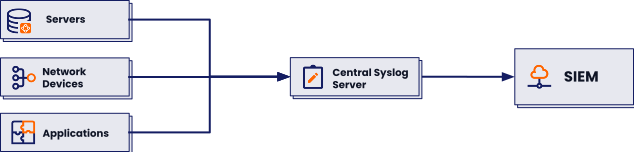
This design decouples log producers from downstream systems, allowing feeding SIEMs, storage, and monitoring platforms to be fed in parallel, with the data relevant to them.
Observability and Analytics Integrations
Beyond security, syslog can play an important role in observability pipelines.
Common Patterns
- Forwarding syslog into log analytics platforms
- Enriching logs before ingestion
- Bridging legacy syslog into modern systems
For example, syslog is frequently used as an ingestion layer before forwarding logs to tools like Grafana Loki, where they can be queried alongside metrics and traces. Example integration patterns are discussed in Send Syslog Data to Grafana Loki.
Filtering, Enrichment, and Routing in Practice
One of syslog’s practical strengths is its ability to process logs in-transit.
Typical production pipelines include:
- Filtering low-value or noisy messages
- Routing different log classes to different destinations, for example:
- Authentication failures → SIEM
- Debug logs → short-term storage
- Compliance logs → immutable archive
This flexibility helps organizations balance cost, performance, and compliance.
Syslog as a Bridge Between Old and New
In many environments, syslog acts as a compatibility layer:
- Legacy systems emit syslog
- Modern platforms expect structured or cloud-native formats
Syslog daemons such as syslog-ng or AxoSyslog (a drop-in replacement for syslog-ng) are often used to:
- Normalize formats
- Add structure
- Forward logs into modern telemetry systems
This makes syslog a pragmatic integration point, even as logging ecosystems evolve.
Key Takeaways
- Syslog is widely used for OS, network, application, and security logging.
- Central syslog servers often act as buffers and routers before logs reach a SIEM.
- Syslog integrates well with observability platforms and analytics tools.
- Filtering and routing capabilities enable cost control and compliance.
- Syslog remains a critical bridge between legacy systems and modern pipelines.
For a complete list of topics covered in this series, see the Comprehensive Guide to Syslog.


Follow Our Progress!
We are excited to be realizing our vision above with a full Axoflow product suite.
Sign Me UpFighting data Loss?

Book a free 30-min consultation with syslog-ng creator Balázs Scheidler