
Syslog Deployment Modes: From Local Logs to Enterprise Pipelines
Syslog is deceptively simple: systems generate messages, and those messages are collected somewhere. But where they’re collected — and how they’re forwarded — has a huge impact on scalability, reliability, security, and compliance.
In practice, syslog is deployed in several distinct modes and architectural variants, ranging from single-host setups to multi-tier, enterprise-grade pipelines feeding SIEM platforms.
In this article, we’ll cover:
- the most common syslog deployment models,
- when to use each, and
- how modern syslog implementations like AxoSyslog fit into these designs.
If you’re not yet familiar with syslog fundamentals, start with How Syslog Works: Core Concepts.
Local Syslog (Single-Host Deployment)
The simplest deployment is local syslog, where logs are generated, processed, and stored on the same host.

Characteristics
- Logs remain on the originating system
- Minimal network overhead
- Easy to configure - most Linux system have this configured out of the box
When It Makes Sense
- Single servers or appliances
- Development or test environments
- Systems without compliance or retention requirements
Limitations
- No centralized visibility
- Logs are lost/unaccessible if the host fails or becomes unaccessible
- Poor fit for audits, forensics, or security monitoring
Local syslog is often the starting point, but rarely the final architecture.
Centralized Syslog Server
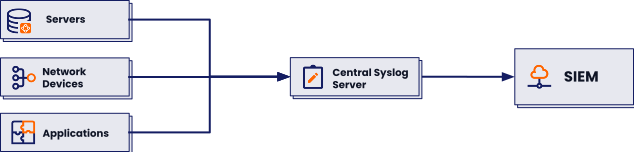
In a centralized model, you have multiple systems that forward their logs to a central syslog server, which becomes the aggregation point for analysis, retention, and forwarding.
Characteristics
- Central point for log collection
- Simplifies monitoring and troubleshooting
- Enables consistent retention and access control
Compliance & SIEM Integration
In many organizations, the central syslog server is either:
- A SIEM, or
- A log collection layer that forwards events to a SIEM
This model supports:
- Audit trails
- Incident response
- Regulatory requirements (PCI DSS, SOC 2, HIPAA, etc.)
Deeper compliance considerations are covered in the blog Syslog Security and Hardening.
Distributed and Hierarchical Syslog Architectures
As environments grow, a single central server can become a bottleneck. Distributed or tiered syslog architectures address this by introducing multiple collection layers.

Why This Model Exists
- Reduces network fan-in (the edge collectors or relays can transport data more effectively, and the central server doesn’t have to maintain connections to thousands of hosts)
- Improves resilience
- Allows local buffering and preprocessing on the edge collectors/relays
Common Use Cases
- Large data centers
- Multi-region environments
- Environments with bandwidth constraints
Edge collectors can:
- Normalize messages
- Filter noise
- Apply routing logic before forwarding upstream
- Ensure encryption during transport, reliable data transfer, and temporary data retention/buffering in case of network errors when the central server becomes unavailable
For scaling patterns, see Scalable Syslog Architectures.
High-Availability & Redundant Deployments
Reliability is critical for logging pipelines — especially when logs are needed for security investigations or compliance audits.
High-availability syslog deployments typically involve:
- Multiple collectors
- Failover targets
- Load-balanced ingestion

However, we recommend using load balancers only if you’ve switched to a transport protocol other than syslog - see Syslog Scaling and Performance Considerations for details.
Reliability Techniques
- Disk-based buffering
- Persistent queues
- Backpressure handling
- Multi-destination forwarding
Modern implementations like AxoSyslog (a drop-in replacement for syslog-ng) are designed with these enterprise reliability patterns in mind. For details, see Disk buffering for a resilient syslog architecture.
Tooling and Implementation Variants
While syslog is a protocol, real-world deployments depend heavily on the syslog daemon used.
Common Choices
- rsyslog
- Proprietary SIEM agents
- AxoSyslog (drop-in replacement for syslog-ng)
Why Implementations Matter
Different implementations vary in:
- Queueing and buffering capabilities
- Parsing and filtering performance
- Extensibility
- Operational observability
In large or compliance-driven environments, these differences directly impact data loss risk and operational stability.
Brief Note on Cloud and Container-Aware Deployments
Modern environments introduce new challenges like ephemeral workloads, short-lived containers, and dynamic infrastructure (for example, IP addresses/hostnames that are only temporarily available, and disappear quickly).
Syslog still plays a role, but is often combined with:
- Sidecar collectors
- Node-level agents
- Forwarders that bridge syslog into modern telemetry pipelines
This topic is covered in depth in the blog Advanced Syslog Topics.
Security and Compliance Considerations at a Glance
Deployment choices are often driven by security and compliance needs, such as:
In many environments, syslog deployment decisions are driven less by convenience and more by security, compliance, and audit requirements. Regulations and standards such as PCI DSS, SOC 2, HIPAA, ISO 27001, or internal security policies often specify security and compliance requirements, such as:
- Centralized retention
- Tamper resistance
- Access control
- Ensuring the encryption and integrity of the logs in transit and at rest
- Ability to search and monitor the logs
- Resilience and reliability
Local-only logging rarely meets these requirements, as logs can be altered or lost if a system is compromised or fails.
Centralized or hierarchical syslog architectures help address these concerns by ensuring logs are exported from the source system as quickly as possible. Forwarding logs to a dedicated central server — or directly to a SIEM — reduces the risk that attackers can erase evidence of their actions by modifying local log files. In modern, security-aware environments, syslog traffic is commonly sent over TLS, combining authentication and encryption, to protect log integrity and confidentiality in transit.
Another key consideration is chain of custody and reliability. Compliance frameworks often expect logging pipelines to tolerate outages without data loss, which makes features like disk buffering, persistent queues, and controlled backpressure essential. Many organizations therefore deploy syslog servers not just as passive collectors, but as hardened infrastructure components whose primary role is to reliably ingest, buffer, and forward events to a SIEM or long-term storage layer. These concerns — including secure transport, integrity guarantees, and audit readiness — are explored in depth in the upcoming blog Syslog Security and Hardening.
Key Takeaways
- Syslog can be deployed in multiple architectural modes, from local to enterprise-scale.
- Centralized and distributed deployments improve visibility, resilience, and compliance.
- High-availability designs are essential when logs are security- or audit-critical.
- Tooling matters — modern implementations like AxoSyslog enable reliability at scale.
- Cloud and container environments require adapted patterns, not abandonment of syslog.
Understanding these deployment variants helps you design a logging pipeline that scales with your infrastructure — without sacrificing reliability or compliance. For a complete list of topics covered in this series, see the Comprehensive Guide to Syslog.


Follow Our Progress!
We are excited to be realizing our vision above with a full Axoflow product suite.
Sign Me UpFighting data Loss?

Book a free 30-min consultation with syslog-ng creator Balázs Scheidler