
CrowdStrike Next-Gen SIEM: Cut Ingest Costs and Keep Falcon Data for Years
CrowdStrike Falcon is the endpoint platform of choice for a lot of security teams, and Next-Gen SIEM looks like the natural next step: one vendor, one console, and detections already tuned for Falcon data. The business case usually holds up until two costs show up. Keeping Falcon data past the standard retention window gets expensive fast, and bringing in everything that isn't Falcon data, like firewall, network, and cloud logs, costs even more.
Axoflow works on both sides. It pulls CrowdStrike's own data out into long-term, searchable storage, and it cuts down what goes into CrowdStrike before it's billed. You end up with a SIEM that holds what your detections need and an archive that holds everything else for years.
The Real Cost Isn't Detection. It's Retention and Ingest.
CrowdStrike's detection is strong. The cost problems come from how data gets in and how long it stays:
- Retention gets expensive fast. Endpoint telemetry runs to terabytes a day, even in smaller environments. Most teams keep Falcon data for 30 days or less because longer retention costs too much.
- Third-party data costs more. Logs from Palo Alto, Fortinet, Cisco, Meraki, Infoblox, and cloud services aren't native Falcon data, so they're priced higher. Teams that grow their intake can end up well over their license.
- Falcon isn't a log collector. The Falcon agent sends security-relevant events to the cloud in batches. It doesn't stream Windows event logs or syslog, so you still need a collection layer.
- Volume-based vendors have no reason to help you send less. When the bill grows with ingest, reduction has to happen before the SIEM, not inside it.
Each of these gets fixed in the data layer, before CrowdStrike ever sees the data.
Keeping Falcon Data for Years with FDR and AxoLake
Falcon agents should keep reporting to CrowdStrike natively. That's where detection runs, and CrowdStrike doesn't charge extra for agent data inside its standard window. The cost comes with keeping it longer. Falcon Data Replicator (FDR) delivers a bit-for-bit copy of the Falcon data CrowdStrike collects, and Axoflow turns that copy into a searchable archive:
- Built-in FDR connector. In AxoConsole, add a CrowdStrike FDR connector rule and pick the AxoRouter that runs it. A ready-made CrowdStrike FDR flow sends events to storage, and they're searchable within minutes.
- Compression you can measure. Each router's Stores view shows raw bytes in versus bytes on disk. A 1.7 GB sample of FDR data lands as 275 MB, and we size AxoLake on roughly 8x compression over a full day.
- Warm, searchable storage. AxoLake writes open Parquet files that are indexed as they land. There's no cold tier to thaw. Analysts search years of Falcon data from AxoConsole, and AI agents perform noticeably better on pre-indexed data than on raw logs.
- Rehydration on demand. When an investigation needs older events back in CrowdStrike, search the lake and send only the matching events to Next-Gen SIEM.
- Retention that fits the requirement. Keep 30 days, 90 days, a year, or up to 7 years for regulated and government environments. Storage can be Axoflow-hosted, in your own S3 bucket, or fully on-prem for air-gapped sites.
Pricing comes down to two inputs: average GB per day and retention in days. A multi-year Falcon archive becomes a predictable line item instead of a reason to delete data.
Reducing What Goes Into CrowdStrike
AxoRouter sits in front of Next-Gen SIEM and shapes third-party data before it's billed:
- Automatic classification and parsing. AxoRouter identifies each source as it arrives, with 300+ parsers out of the box. No regex and no port-per-source setup.
- Keep what detections use, drop the rest. For Azure Event Hubs, the flow keeps security-relevant categories like audit, sign-in, and Graph activity, then strips empty and redundant fields. Against a live CrowdStrike tenant, this cut bytes sent by 82%, and Axoflow's input count matched CrowdStrike's own ingest figure to within a few percent.
- Normalized for the destination. The Falcon Next-Gen SIEM HEC destination sends normalized events and can leave out the raw message copy, which trims every payload.
- Routing by value. Alerts and interactive logs go to CrowdStrike. High-volume, low-value telemetry goes only to AxoLake, still searchable and ready to rehydrate.
- Direct HEC delivery. Native HEC removes the intermediate collector host often used to forward syslog into CrowdStrike, so there's one less box to run and troubleshoot.
Results depend on the source mix. Expect around 40% with minimal tuning, 25 to 60% across a typical CrowdStrike source mix, and around 70% where firewall and cloud logs dominate. Axoflow shows input versus output per flow, so you can check the numbers against what CrowdStrike reports for the same 24 hours.
How It Fits Together
Both sides run on the same AxoRouter, managed from one AxoConsole, so storage and reduction aren't two separate projects.
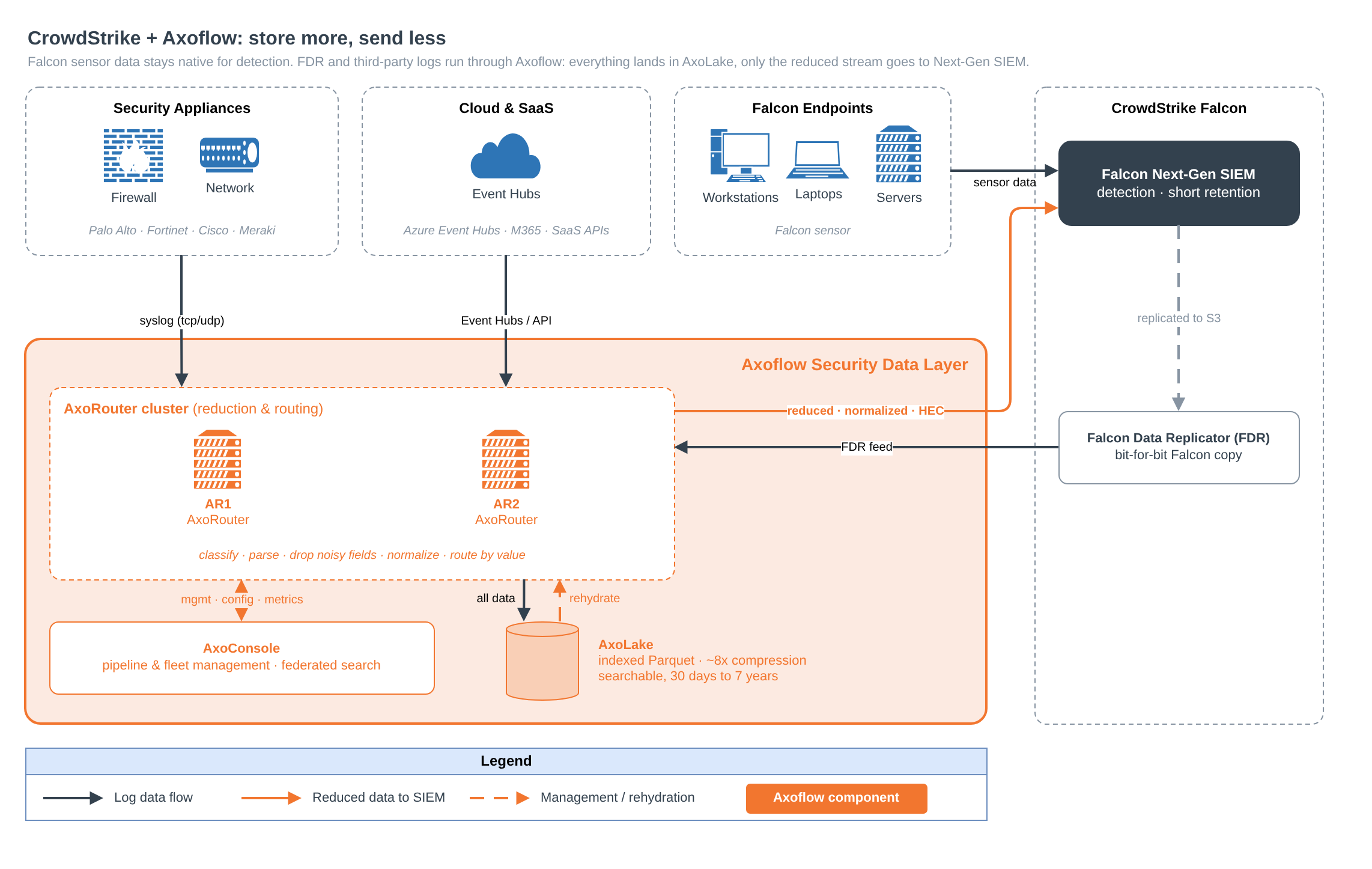
Falcon agents keep reporting to CrowdStrike natively. FDR and third-party logs run through AxoRouter: everything lands in AxoLake, and only the reduced, detection-relevant stream goes on to CrowdStrike over HEC.
Best Practices for Running Axoflow with CrowdStrike
- Leave Falcon agent data where it is. Let agents report natively, and use FDR to copy that data into AxoLake for long-term retention.
- Ask CrowdStrike how ingest is measured. Is it billed before or after parsing and enrichment? What does non-Falcon syslog cost? What happens to data you already keep somewhere else?
- Route third-party sources through Axoflow first. Reduce and normalize before the HEC destination, not after the invoice.
- Decide per source what CrowdStrike actually needs. Detection inputs go to the SIEM. Everything else goes to the lake.
- Measure a full weekday. Compare Axoflow output with CrowdStrike's ingest numbers over 24 hours. Weekly averages undercount because weekends run lighter.
- Set retention by requirement, not budget. With compressed, searchable storage, keeping 1 to 7 years is a storage decision instead of a SIEM license decision.
Axoflow is priced in flat tiers by average GB per day, fixed for the contract term, with no charge per router or agent. The pipeline cost stays steady while the CrowdStrike bill comes down.
CrowdStrike is strong at endpoint detection. It doesn't also have to be your most expensive log archive. Request a demo to see both sides running against your own data.

Follow Our Progress!
We are excited to be realizing our vision above with a full Axoflow product suite.
Sign Me UpFighting data Loss?

Book a free 30-min consultation with syslog-ng creator Balázs Scheidler